
Thinking of Using Ozone Treatment in Mold Remediation? Think Again…
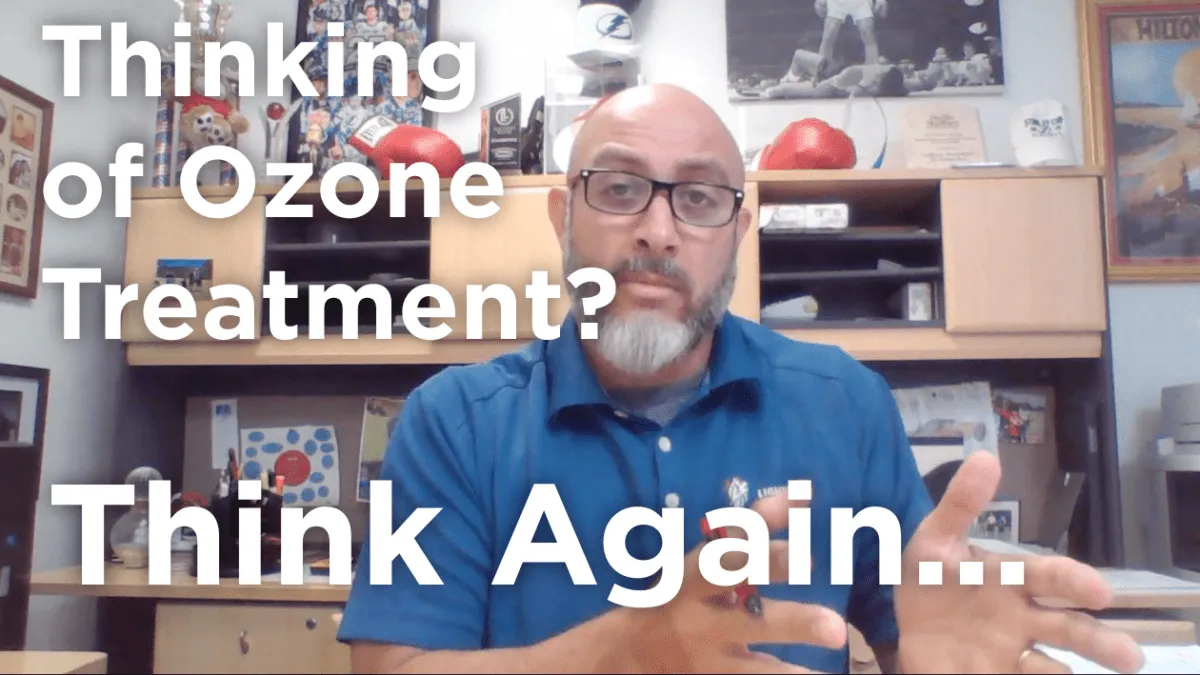
Today, let’s talk about the use of ozone in mold remediation. Ozone is the latest in a long list of magical bullet mold remediation services. Companies have made it available as a discounted alternative to mold remediation. If you’re a property owner considering hiring a company to perform an ozone treatment, there are some things that you really need to know.
OZONE CAN BE HAZARDOUS INSIDE YOUR HOME OR OFFICE
First, ozone is very good at killing mold spores, which is what they advertise. However, on the hierarchy of services that are needed for mold remediation, killing mold spores is at the bottom or not even on the list at all.
Using ozone in such a highly concentrated manner inside a property comes with side effects. Inhaling ozone is extremely bad for your health and can cause permanent respiratory problems. The American Lung Association says that breathing in ozone is the equivalent of having sunburn on the inside of your lungs.
If these health risks aren’t bad enough, there’s a laundry list of side effects to the actual home itself, including rapid deterioration of rubber and plastic. Take a second to think of everything in your home made of rubber, such as the rubber gaskets for your plumbing system. If these were rapidly deteriorated and damaged, they will begin sprouting leaks. Then, with this new water damage, you will be almost back to square one and, as a result, possibly experience more mold damage. Then, think about the plastic in your property: your electronics, your appliances, the electrical system itself. All of these electrical wires are wrapped in plastic. The deterioration of this plastic could cause a fire and has in the past. As a result of these fires, a number of lawsuits have resulted from use of highly concentrated ozone in properties.
COMPANIES WILL STILL USE OZONE FOR MOLD REMEDIATION
Because of the lawsuits and resulting regulations from the FDA, OSHA, and the EPA, you will never find a company that advertises using a concentrated blast of ozone in the house. Instead, these companies will refer to “energized oxygen,” which will create a pure air environment and produce a springtime odor. This is fine if our goals are to deodorize or have our clothes smell better from a fabric softener. For mold remediation, though, this really is not what we’re looking to accomplish. Our goal to bring this property back to a healthy living or working environment.
HOW DO WE PERFORM MOLD REMEDIATION WITHOUT OZONE?
For this reason, industry experts around the world have performed tons of research and experimentation to find the best methods for getting rid of mold and bringing you back to those healthy living environments. It always comes back to the same process, and that is a HEPA filtration cleaning process. Supporters of ozone treatment will always say the same thing: by doing HEPA filtration, you’ll never kill or get rid of 100% of the spores. This is actually true; you won’t, and it doesn’t really matter. An actual healthy home’s mold levels should be about the same as what you find outside. As you come in and out of your home or office, you’re bringing mold in and out with you, so what does it matter if you killed and eradicated 100% of the actual mold spores? You’re just going to bring more in with you as soon as you’re done.
In addition to this, we must remember that mold spores are not what really cause you to get sick. These carry mycotoxins, which is what causes illness. The mycotoxins, being microscopic poisons, are present because of the mold, and they attach themselves to mold spores. They also attach themselves to other fungi, called hyphae. When you breathe these in, you actually get sick. If there are no supplemental services on top of the actual ozone treatment to remove all of those fragmented pieces that carry all those mycotoxins and even those dead spores that are there, it really doesn’t matter that you’ve killed them. You’re still going to get the same type of adverse health effects from the mold. Again, that’s not what we’re trying to accomplish.
TRUST LIGHTNING RESTORATION WITH YOUR MOLD TROUBLES
Here at Lightning Restoration, we follow the state of Florida guidelines for mold remediation. We use the nationally and internationally recognized process for performing mold remediation, which is a HEPA filtration cleaning process. We guarantee our services 100%. If for any reason we didn’t pass after the first test and need to clean again, we would clean for free. We would even pay for that hygienist to come back and test for a second time.
Which brings me to my next point: If you’re having mold remediation performed in your home, you want a third party industrial hygienist to come in and do the testing upon completion to ensure that your property is back to a healthy environment. We see some situations regularly when it comes to ozone treatments:
- They either do not get a test at all, or
- They do the test themselves.
If they’re doing the test themselves, they’ve actually adjusted the test to their benefit. The test will show they’re doing what they set out to accomplish, which was simply, once again, to kill the mold spores. Meanwhile, they will never address the mycotoxins and the fact that you still have those mold fragments present that make you sick. Remember always:
- Utilize a third party,
- Rely on an industrial hygienist,
- Require testing upon completion.
If you have questions about mold remediation or the use of ozone, we’d be happy to discuss more of it with you. If you have mold concerns, give us a call. We come out to your property. We do a free consultation. When it comes to mold remediation, you have the right to choose whoever does work in your property. We’d love it if you chose Lightning Restoration.
Frequently Asked Questions About Ozone Treatment for Mold
1. Does ozone kill mold?
Ozone can damage or inactivate some mold and other biological organisms under sufficiently high concentrations and controlled conditions. However, that does not mean ozone is a complete mold-remediation solution. At concentrations considered acceptable for public-health exposure, ozone is not effective at removing mold from indoor environments. It may also fail to reach mold growing inside porous materials. Effective mold remediation requires addressing the moisture source and physically removing mold contamination rather than simply trying to kill mold spores.
2. Will an ozone generator kill mold?
An ozone generator may kill or inactivate some mold spores when ozone concentrations are high enough, but using an ozone generator does not eliminate the underlying mold problem. The EPA advises against using ozone generators in occupied spaces because ozone is a lung irritant. High concentrations can also damage certain materials, including rubber, fabrics, and electrical wire coatings. For these reasons, an ozone generator should not be considered a substitute for professional mold remediation.
3. Does an ozone machine kill mold, or do ozone machines kill mold completely?
This is where the distinction between killing mold and remediating mold matters. An ozone machine may affect some airborne mold spores under controlled conditions, but it does not guarantee that mold contamination has been removed from walls, ceilings, insulation, furnishings, or other porous materials. Dead mold and contaminated particles can remain in the property. Proper ozone mold treatment therefore should not be viewed as a complete replacement for source removal, containment, cleaning, and filtration.
4. Do ozone generators kill mold better than professional mold remediation?
No. Ozone generators and professional mold remediation serve very different purposes. Ozone mold remediation attempts to use a reactive gas to affect biological contaminants, while professional remediation focuses on finding and correcting the moisture problem, containing the affected area, and physically removing or cleaning contaminated materials. EPA guidance emphasizes moisture control and cleanup as the way to address a mold problem.
5. Will an ozone machine kill mold and make my home safe?
Not necessarily. Even if an ozone machine kills or inactivates some mold spores, that does not prove the property has been successfully remediated or that all contaminated materials have been cleaned. Ozone itself can also be hazardous at elevated concentrations. If you suspect mold, the goal should be to remove the source of contamination and correct the moisture problem, not simply make the mold spores inactive. A qualified remediation professional and, where appropriate, an independent third-party assessment can help determine whether the property has been properly cleaned.